

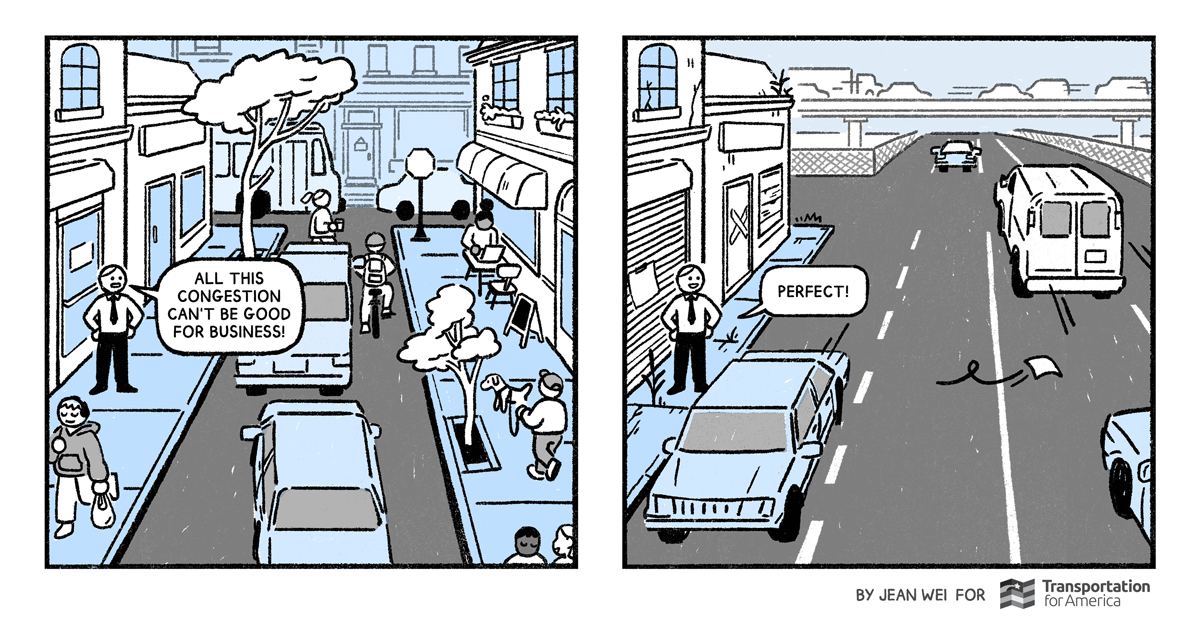
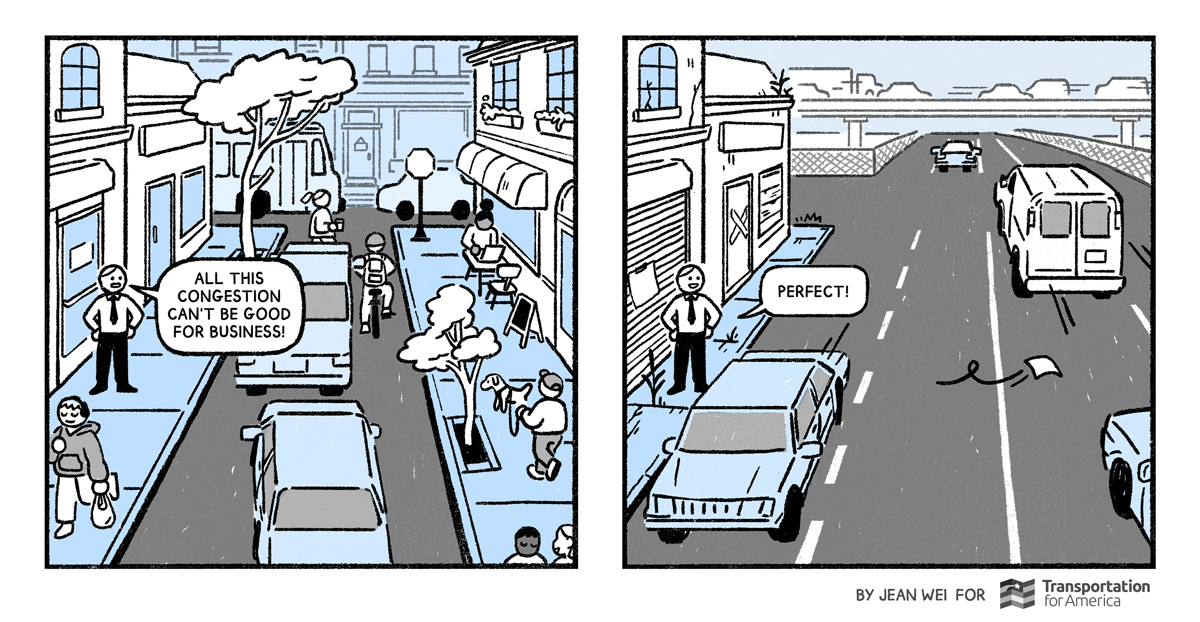
Last week, we talked about the benefits of congestion. This week, let’s consider the role that the surface transportation sector must play if we are serious about generating the most congestion possible.
For decades, transportation agencies across the country at all levels of government have been trying to reduce traffic congestion by adding roadway capacity. This has backfired spectacularly (see: Congestion Con and your own experience). But they have not changed their strategy, and most elected officials and many taxpayers and stakeholders (many who make money off this system) have been totally undeterred by this total failure. That’s the spirit!
Fundamentally, maximizing congestion requires that we keep as many people as possible on the road, preferably alone in separate vehicles, for as long as possible. But this is not sufficient. It is also necessary to spread out destinations (which will be covered more in a future section on land use and development) and to build disconnected roadway networks that are operated inefficiently.
The transportation agency actions that can encourage more people to drive and take more and longer driving trips include:
Design roadway systems that are circuitous, fragmented, and disconnected, avoiding grids and redundancies.
Congestion booster: ensure that any traffic signals or control devices are not coordinated.
Design roadways with vehicle-only procedures, traffic modeling, and design measures (such as Level of Service). Require traffic modeling for a time period that is too long to be accurately modeled (e.g., 20 years or longer), allow or encourage overestimates of traffic, and ensure model projections are not checked for accuracy.
Congestion booster: prohibit sidewalks, crosswalks, or bike lanes or at least discourage them by refusing to fund maintenance or creating bureaucratic hurdles to putting them in or requiring more bureaucratic steps for projects that reduce vehicle capacity than any project increasing it.
Do not consider potential trips from origin to destination that people take but, rather, only the fluidity of vehicle movements within a roadway project area.
Congestion booster: define congestion reduction as “time savings” that in turn is measured only by the speed of vehicle movement, allowing interventions that increase travel distance and cause trips to take more time to count as saving time.
Congestion booster: further define slow moving vehicle traffic as bad for the economy even when economic activity and access to jobs and necessities is high. Conversely, define fast moving vehicle traffic as good for the economy even when economic activity and access to jobs and necessities is low.
Keep vehicle speeds high on streets and roadways, especially those with many points of conflict (e.g., on street parking, cross streets, driveways, and crosswalks) using designs like wide vehicle lanes (eg, 12 ft) and setting speed limits based on the highest speeds observed.
Danger booster: set high speed limits legislatively.
Danger booster: aggressively “share” the responsibility for safety with the users of your system and ensure that transportation agencies are strictly protected from liability no matter the safety performance of their designs.
Guarantee funding for investments that support vehicle movement but not for any other form of transportation.
Keep long-range transportation planning, goal setting, and performance management separate from project investment decision-making.
Emerging congestion opportunities:
Allow automated vehicles to travel empty for long periods of time.
Prohibit any existing congestion pricing regimes (e.g., tolling, congestion pricing, paid parking, etc).
There are many other actions that transportation agencies could take to promote congestion. But those listed here are fundamental.
Stay tuned for the next congestion maximization section which will focus on the role of land use and zoning.
[Sarcasm aside, it is important to understand that everything above is either standard or common and very hard to avoid. No amount of money or special new programs can overcome this. These internal procedures must change if we want different outcomes. ]